

VONG and VOOG are among the best growth ETFs from the Vanguard powerhouse.
Both VONG and VOOG charge the same low expense ratio and offer identical dividend yields.
Both funds are heavily invested in technology stocks, with top positions including Nvidia and Apple.
These 10 stocks could mint the next wave of millionaires ›
For investors seeking exposure to the broad U.S. stock markets, the Vanguard Russell 1000 Growth ETF (NASDAQ:VONG) and the Vanguard S&P 500 Growth ETF (NYSEMKT:VOOG) stand out as two low-cost, index-tracking ETFs from Vanguard. Both ETFs track large-cap U.S. growth stocks, but differ in their index construction, sector tilts, and historical returns.
VONG and VOOG target the high-growth segment of the U.S. equity market, but VONG follows the Russell 1000 Growth Index, while VOOG tracks the S&P 500 Growth Index. The matchup below explores which ETF may appeal to you based on your preferences for cost, performance, and portfolio makeup.
Metric
VONG
VOOG
Issuer
Vanguard
Vanguard
Expense ratio
0.07%
0.07%
1-yr total return (as of Dec. 31, 2025)
18.5%
22.1%
Dividend yield
0.43%
0.54%
Beta
1.16
1.08
AUM
$44.6 billion
$21.6 billion
Beta measures price volatility relative to the S&P 500; beta is calculated from five-year weekly returns. The 1-yr return represents total return over the trailing 12 months.
Both funds are equally affordable, with an expense ratio of 0.07%, and each distributes a modest 0.5% dividend yield, making cost and yield a wash between the two choices.
Metric
VONG
VOOG
Max drawdown (5 y)
(32.7%)
(32.7%)
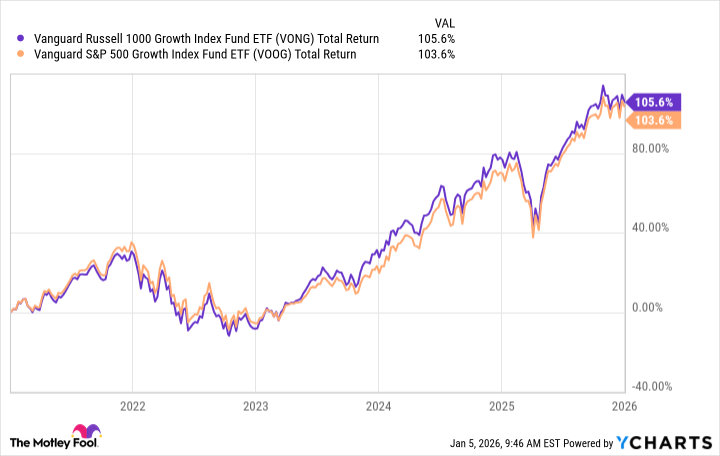
Growth of $1,000 over 5 years
$1,987
$1,961
The Vanguard S&P 500 Growth ETF tracks the S&P 500 Growth Index, comprising large-cap growth stocks with 217 holdings. It has a heavy technology tilt (41.4%), followed by communication services (16.75%) and consumer discretionary (11.86%). Its top positions are Nvidia (NASDAQ:NVDA) at 13.51%, Apple (NASDAQ:AAPL) at 5.96%, and Microsoft (NASDAQ:MSFT) at 5.95%. VOOG has a long history with more than…
..